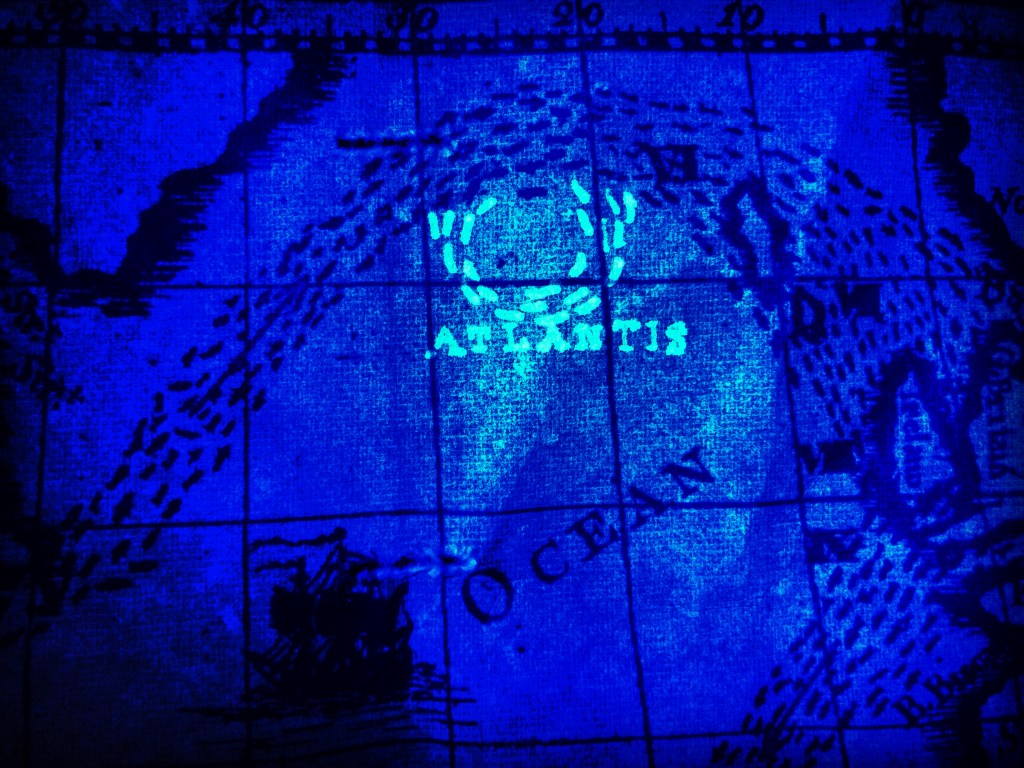
Holy smokes! I was trying a few experiments to see if there was any invisible ink on the map. I tried a few tricks like lemon juice and vinegar with no luck. When I turned on a blacklight, Atlantis lit up like a Christmas tree! I know I got lucky this time because they didn’t have blacklights back then and I’m not sure what type of invisible ink was used. Just knowing that there is more in this book than what’s visible at first glance is both exciting and nerve-racking. I don’t want to miss anything. Please let me know if you see anything in these images I’m uploading.
Estevanico – First African man to explore America. (1500-1539?)
“An anonymous source has sent an old letter to my office. It is a brief autobiography from a man named Estevanico. He was a Moroccan man who became a slave to the Spanish, and he may have been the first African man to step foot on American soil. King Charles V sanctioned the Narváez expedition to explore Florida in 1528. Storms forced the ships to take shelter along the east coast in the Gulf of Mexico. The expedition leader Narváez ordered the ships to continue sailing north in search of a large port while he led the majority of his crew by foot. He made a huge miscalculation and never saw his ships again. Narváez had the men build canoes to travel as far as they could along the coast. Another storm separated the boats and crew. All perished expect for Estevanico and three others who washed ashore on what is now Texas. Estevanico survived by learning the languages of several Native American tribes. He convinced them that he was a healer and was thereafter respected as a medicine man. After 8 years, the four men finally entered Mexico City and told their story. The Spanish Navy brought Estevanico to Spain to speak before King Charles V. He told the king a wonderous tale of the Seven Cities of Cibola. A legend not only described by Native Americans, but one that he saw with his own eyes. Each city is brimming with gold. Gold bricks construct the brilliant architecture. Every citizen wears gold jewelry and intricately woven gold clothing. Even the streets are paved with gold. The story enchanted the Spanish king, and he sent a new expedition to America. This time, Estevanico was to guide the Spanish to this golden city. However, Estevanico was not granted his freedom and instead continued on as a slave to the Spanish. He felt betrayed and knew that he would need to take destiny into his own hands. In 1539 they left Mexico City on this new expedition and Estevanico traveled ahead of the group to communicate with the Native Americans before the party’s arrival. The expedition arrived at the next village to learn that the Native Americans had killed Estevanico. With their plans for further expedition ruined, they were forced to head back. Though all was not as it seemed. The Native Americans had lied and helped Estevanico fake his death. He lived the rest of his life as a respected medicine man. In his old age, he wrote down his story in the hopes that people would remember his legacy. His story is inspiring and Estevanico was a true survivalist. The Seven Cities of Cibola sounds like a grand tale and the part of me that loves adventure wishes it were true. The French and Spanish control most of the land to the west. If we were ever to continue exploration for these cities, the United States would need make arrangements with those countries.
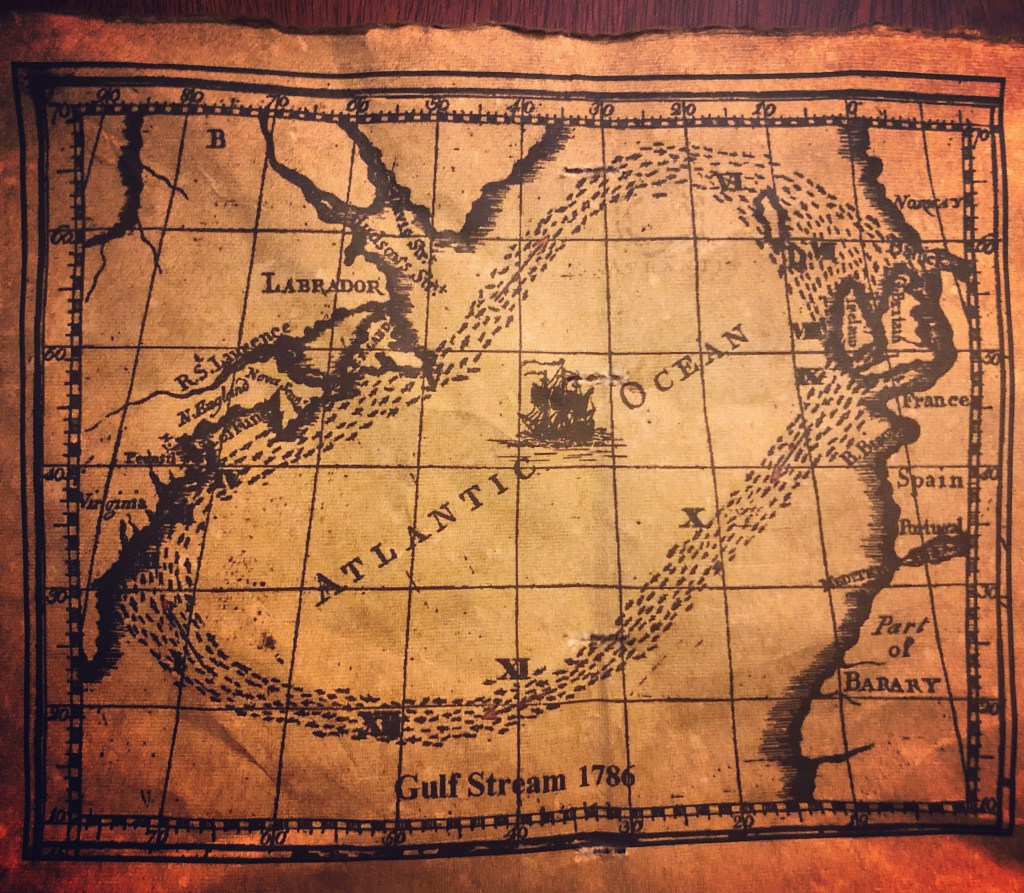
Map of the Gulf Stream by Benjamin Franklin in 1786 – Hidden Atlantis?
“Benjamin Franklin’s discoveries and experiments are well-known by now. His efforts to map the currents of the Atlantic Ocean have greatly improved trade with Europe. One such map is different and was passed to me by George Washington who wished to keep it secret except between Presidents. During one of Franklin’s trips to France, they encountered a terrible storm between Greenland and Iceland that forced their ship farther south than the gulf stream. They began experiencing strange anomalies that Franklin took careful note of. He documented interesting electrical phenomena such as St. Elmo’s fire that glowed much brighter than usual, lightning that appeared to gather as if in a sphere, and unusual whirlpools threatening to draw down the entire ship. Franklin and the crew were happy to survive the storm. Amazingly, the old rascal was stubborn enough to take measurements of the area using his scientific tools. He has proposed an idea, however he is ever skeptical of his findings. He believes he may have found the location of Atlantis, the great city written about by Plato, the Greek philosopher. He believes that an energy surrounds the ancient city which may be the cause of the strange phenomenon and eddy created in the Atlantic. Proof of the ancient city could be instrumental in understanding our past. Unfortunately, if the legend is true, I fail to see how men could ever reach the depths of the ocean to discover its vast wealth of information. There will always be men like Franklin who never cease to amaze with their brilliance. Perhaps this information may be of more use to others in the distant future.
-John Adams 1799″
This is huge! Easily the biggest revelation so far. Although, I’m not seeing Atlantis anywhere on this map.
“I successfully obtained a favorable loan from the Dutch royalty to help fund our war of independence. However, I suspect this money may have had deceitful intentions. We must seek opportunities to make our country independent in terms of wealth as well as government. Surely the vast quantities of natural resources untouched and undiscovered by man could provide the means. Gaining our independence might be for nothing if others end up owning us with unfavorable debts.
-John Adams 1782″
Early on the Presidents were driven by this idea to keep America independently wealthy.





 The U.S. President's Book of Secrets